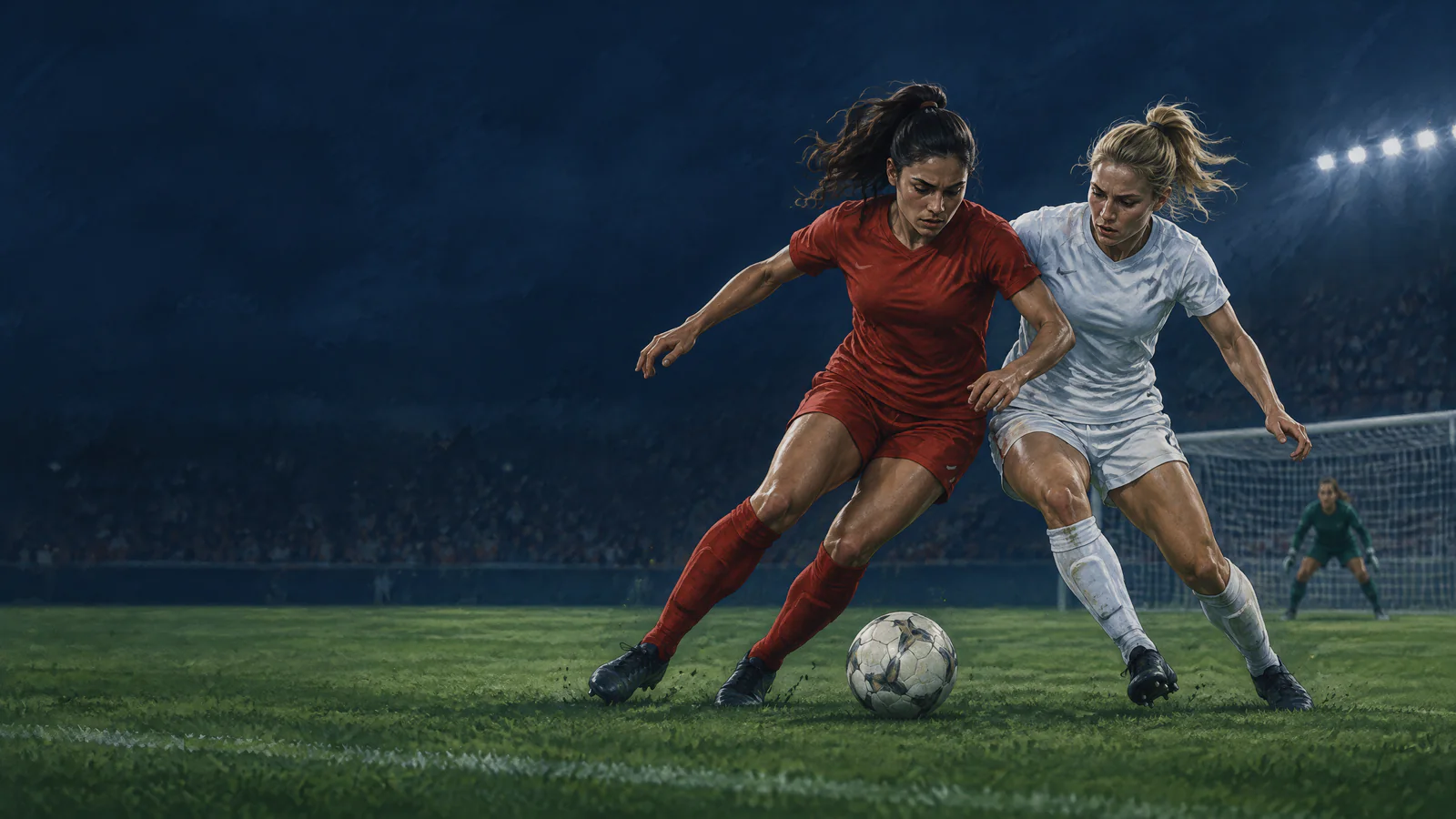
A denial of an obvious goal-scoring opportunity, usually shortened to DOGSO, is one of football’s most consequential disciplinary decisions. It is not a label for any foul by the last defender, nor is it decided simply by whether an attacker appears to be one-on-one with the goalkeeper. The question for the referee is what the offence stopped: did it take away an opportunity that was genuinely obvious?
DOGSO is a judgment about the lost chance, rather than a separate description of how hard, reckless or cynical the contact looked. A minor trip, hold or push can lead to a sending-off if it prevents an obvious chance. Equally, a more dramatic-looking incident may not meet the DOGSO threshold if the attacking situation was not sufficiently clear.
The four considerations behind DOGSO
The Laws require referees to consider four connected features of the situation. They examine the distance between the offence and the goal, the general direction of play, the likelihood that the attacker would keep or gain control of the ball, and the location and number of the defenders and attackers. UEFA presents the same framework in its referee guidance, describing those factors as the basis for deciding whether the opportunity was obvious.
None of those considerations operates as a stand-alone test. An attacker may be close to goal but chasing a ball they are unlikely to reach. Another attacker may have possession and be moving forward, but still have a defender in a position to challenge. In either case, the referee has to assess the entire picture at the instant of the offence, not pick one favourable detail and treat it as decisive.
Direction is assessed through the overall movement of the play. A forward touch that goes slightly across the field does not, by itself, settle the matter; nor does the attacker need to be running in a perfectly straight line. The key issue is whether the attack as a whole was developing towards the offender’s goal. Distance affects how immediate and realistic the chance was, while control matters because a loose ball is not automatically a chance the attacker would have converted into a shot.
The defenders’ positions are equally significant. The common phrase “last defender” can be useful shorthand in commentary, but it is not the legal test. A player can be the rearmost defender and still avoid a DOGSO dismissal if another defender could realistically intervene, the ball was not under likely control, or the movement of play did not point sufficiently towards goal. Conversely, the referee’s analysis is about effective defensive cover, not merely a headcount of players behind the ball.
Why the location and type of offence change the card
When DOGSO is established, the normal Law 12 outcome for an offence punishable by a free kick is a sending-off. There is, however, an important qualification for offences against an opponent inside the offending team’s own penalty area when the referee awards a penalty kick. If the defender’s offence was an attempt to play the ball or a challenge for the ball, the player is cautioned rather than sent off.
That qualification is narrow. It does not mean every DOGSO incident in the penalty area produces a yellow card. The referee must still decide that the player was attempting to play or challenge for the ball. IFAB identifies holding, pulling, pushing and situations with no possibility of playing the ball as circumstances in which the offending player must be sent off. UEFA’s guidance makes the same distinction: an in-area offence that was not an attempt to play or challenge for the ball remains a situation in which a red card may be required when the DOGSO criteria are clearly met.
The contrast explains why similar incidents can produce different sanctions. A mistimed challenge for a reachable ball and a shirt pull may both prevent an attacker from shooting. But the first can fall within the penalty-area caution provision if all its conditions are met; the second is not treated as an attempt to play the ball. The referee is therefore judging both the quality of the chance and the nature of the defender’s action.
Deliberate handball is addressed separately in Law 12. The Laws list denying a goal or obvious goal-scoring opportunity by deliberate handball as a sending-off offence, with the stated exception for a goalkeeper handling the ball within their own penalty area. This is why analysis should not assume that the in-area treatment of a challenge for the ball automatically answers every DOGSO scenario.
DOGSO is not the same as a promising attack
A referee can conclude that a foul stopped a dangerous move without concluding that it denied an obvious scoring opportunity. Law 12 separately covers offences that interfere with or stop a promising attack, which are generally cautionable. The difference is not whether an attack looked useful; it is whether the scoring chance had become obvious under the full set of DOGSO considerations.
This distinction is central to close calls. If the attacker was still far from goal, the ball was difficult to control, or defensive cover remained available, the referee may decide that the opportunity was promising rather than obvious. That outcome can be frustrating for supporters who see an attacker in open space, but the Laws require a higher threshold before DOGSO is established.
The referee and VAR process
The on-field referee retains the authority to decide the facts of the incident and apply the Laws. Where VAR is in use, DOGSO can fall within the direct-red-card review category. UEFA says VAR should recommend a red-card intervention when all DOGSO criteria are clearly satisfied and the referee either missed the offence or failed to recognise the DOGSO element.
The reverse is also true. UEFA says a red card should be reconsidered when one or more DOGSO criteria are not met, such as when the attacker was unlikely to control the ball, another defender could reach it or challenge, or the direction of play did not support an obvious opportunity. If doubt remains about a relevant criterion, UEFA’s guidance says VAR should not intervene. That reflects the wider VAR principle set out by IFAB: video assistance addresses a clear and obvious error or a serious missed incident, while the referee makes the final decision.
A DOGSO call is therefore not a mechanical verdict from a single camera angle. Officials must identify the offence, place it in the developing move, evaluate the attacker’s realistic prospect of control and progress, and assess the available defensive cover. Only then do they apply the relevant sanction, including the limited penalty-area provision for a genuine attempt to play or challenge for the ball.
The practical lesson is simple: do not decide the incident from the phrase “last man” or from the fact that an attacker fell near goal. DOGSO is the conclusion reached after the referee weighs distance, direction, control and the positioning of players—and then applies the specific Law 12 consequences to the offence that occurred.
Explore the SportsHub4U Football desk for related fixtures, profiles and verified context.
- theifab.com — Law 12 - Fouls and Misconduct | IFABAccessed 2026-09-30
- theifab.com — Law 5 - The Referee | IFABAccessed 2026-09-30
- uefa.com — Denying an obvious goal scoring opportunity | UEFA.comAccessed 2026-09-30
This story is original SportsHub4U analysis written from the editorial desk’s own reporting perspective. It does not reproduce another publisher’s article. Where a reader identifies a factual point requiring support or correction, the desk reviews the evidence and updates the published record.