Sources and update record
Sources: 6 named sources listed below; 0 with an access date. 6 access dates are not recorded or valid.
Reported status: No separate status recorded. Read the dated article; do not assume it is a live or final result.
Production: No separate production-method record. This is not a claim of human review or first-hand reporting.
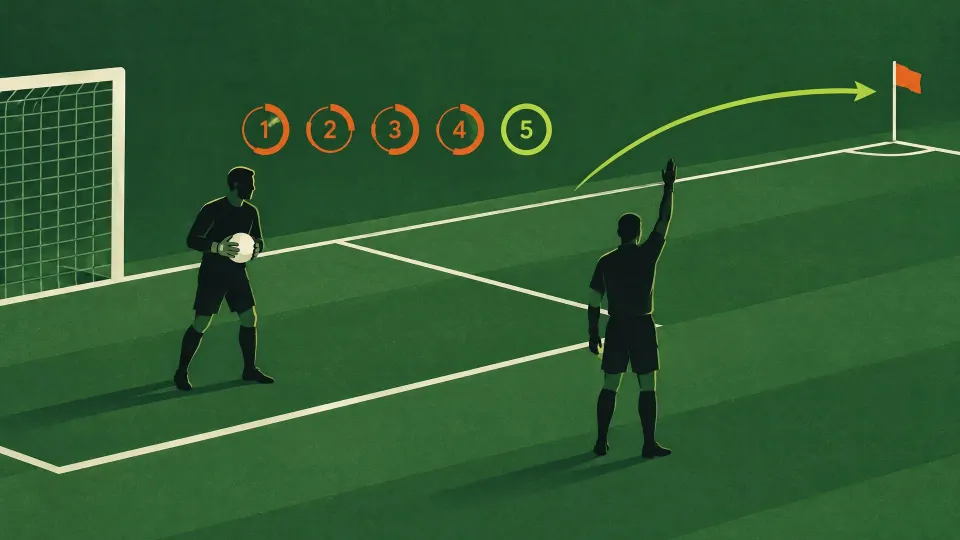
A goalkeeper gathers the ball, drops to the turf and waits. The referee then lifts an arm and begins a visible countdown. If the ball is still in the goalkeeper’s hands when that count ends, the other team can receive a corner kick. That sequence is the eight-second goalkeeper rule, a current Law of the Game aimed at stopping prolonged delays while keeping the consequence clear to players and spectators. It is not a new form of offside, a penalty kick or an automatic booking. It is a specific restart rule for a goalkeeper who has possession with the hands or arms inside the penalty area.
The simple version is this: once the referee judges that a goalkeeper has control, the goalkeeper has no more than eight seconds to release the ball. Holding it longer brings a corner kick to the opponents. The referee is responsible for deciding when control began; spectators do not start the official count when a shot is taken or when the ball first reaches the goalkeeper.
What counts as goalkeeper control?
The clock is about hand or arm control, not merely the ball being near a goalkeeper. The Law defines control broadly. It includes holding the ball between the hands or arms, or between a hand or arm and another surface such as the ground or the goalkeeper’s body. It also includes balancing the ball on an open, outstretched hand, bouncing it on the ground, or throwing it into the air. In other words, a goalkeeper cannot reset the time simply by bouncing the ball before a punt.
That detail matters because a save and control are not always exactly the same instant. A goalkeeper may parry a shot, scramble for a loose ball or be unable to release it safely at once. The referee decides the point at which the keeper is in control, then begins the eight-second allowance. The rule is therefore not an invitation for a crowd to time every save from first contact; the match official makes the decision that starts the count.
The rule is also limited by location. It concerns a goalkeeper who controls the ball with the hands or arms inside their own penalty area. Outside that area, a goalkeeper has the same handling restrictions as any other player, so a different Law issue arises rather than an eight-second corner.
Why does the referee raise an arm?
The first part of the eight seconds is not normally a public countdown. The Law requires the referee to visibly count down the last five seconds with a raised hand. That signal gives the goalkeeper a clear warning and lets both teams see that the threshold is close. It is why a television viewer may notice the referee’s arm only after the goalkeeper has already been holding the ball for a short period.
The visual signal is important because the former rule was different. Before the 2025/26 amendment, the stated limit was six seconds and the restart was an indirect free kick; it was widely described as rarely enforced. IFAB changed the provision after trials and made the new eight-second, corner-kick approach part of the Laws from 1 July 2025.
The purpose is deterrence, not a trap. A visible final-five-second count makes it harder for a goalkeeper to claim surprise, while the prospect of conceding a set piece encourages a faster release. That does not mean every slow-looking action is an offence. The referee still determines control and applies the Law to what happened, rather than to a supporter’s stopwatch.
What is the restart if the eight seconds expire?
If the goalkeeper has not released the ball before the permitted time expires, the opponents receive a corner kick. It is taken from the corner area nearest the goalkeeper’s position when penalised. That location is worth noting: this is not an indirect free kick from where the goalkeeper was standing, and it is not a goal kick.
A corner is a meaningful consequence because it immediately gives the attacking team a chance to put the ball into the penalty area. Still, the rule should not be described as a guaranteed scoring chance. The Law only specifies the restart; whether a team creates a shot or a goal depends on the corner that follows.
The rule by itself does not say that the goalkeeper must receive a yellow card for the first breach. Avoid assuming that a corner for excessive holding automatically produces a caution. Disciplinary action is governed by the circumstances and applicable Laws or competition guidance, while the core eight-second consequence in the Law is the corner kick.
What if an attacker prevents the release?
A goalkeeper in hand or arm control cannot be challenged for the ball. An attacker who prevents the goalkeeper from releasing it commits an offence for which play is restarted with an indirect free kick to the goalkeeper’s team. The Premier League’s published guidance also explains that, if an attacker pressures or prevents release during the count, the referee awards that indirect free kick against the attacker.
This protects the difference between enforcing delay and rewarding interference. An attacker may press the goalkeeper’s distribution options at a lawful distance, but cannot kick at the ball in the keeper’s hands or obstruct the act of release. If interference causes the delay, it should not become a route to a corner for the attacking side.
The rule should also not be confused with the back-pass restriction. The eight-second question is whether the goalkeeper controlled the ball with hands or arms for too long. A back-pass decision asks whether the goalkeeper illegally handled a ball deliberately kicked by a team-mate or received directly from a team-mate’s throw-in. Both can lead to indirect-free-kick issues in the right circumstances, but they are separate tests.
How to read the moment in a match
When watching, use a short sequence. First, ask whether the goalkeeper has genuine hand or arm control. Second, wait for the referee’s raised-hand countdown rather than starting from the save. Third, see whether the goalkeeper releases the ball before the eight seconds end. Finally, check whether an attacker unlawfully prevented the release; if so, the restart may go the other way.
That layered approach is useful beyond this one Law. Football often separates a player’s position from an offence, as in why a player can be offside without committing an offside offence, and separates an in-match restart from the procedures that decide a drawn tie, explained in our football penalty shoot-outs guide. Here, the key distinction is equally clear: possession is not automatically time-wasting, but keeping the ball beyond the referee’s eight-second limit produces a corner.
- The FA — The FA — Law 12: Fouls and Misconduct (IFAB Laws of the Game 2026-27)Accessed 25 September 2026
- The FA — The FA — Law 17: The Corner Kick (IFAB Laws of the Game 2026-27)Accessed 25 September 2026
- IFAB — The IFAB — The IFAB tackles time-wasting by goalkeepersAccessed 25 September 2026
- BBC Sport — BBC Sport — What is the eight-second rule?Accessed 25 September 2026
- FIFA — FIFA — The IFAB tackles goalkeeper time wastingAccessed 25 September 2026
- ESPN — ESPN — What’s new in the Premier League: War on holding, keeper rule, RefCamAccessed 25 September 2026
This article presents SportsHub4U editorial coverage. Where recorded, supporting sources and their access dates appear below. A publication-control check is not a human reviewer’s endorsement or a guarantee of factual accuracy. See the editorial standard for automation and correction procedures.