Sources and update record
Record updated: . This is the saved modification date, not a separate fact-check date.
Sources: 3 named sources listed below; 3 with an access date.
Reported status: No separate status recorded. Read the dated article; do not assume it is a live or final result.
Production: No separate production-method record. This is not a claim of human review or first-hand reporting.
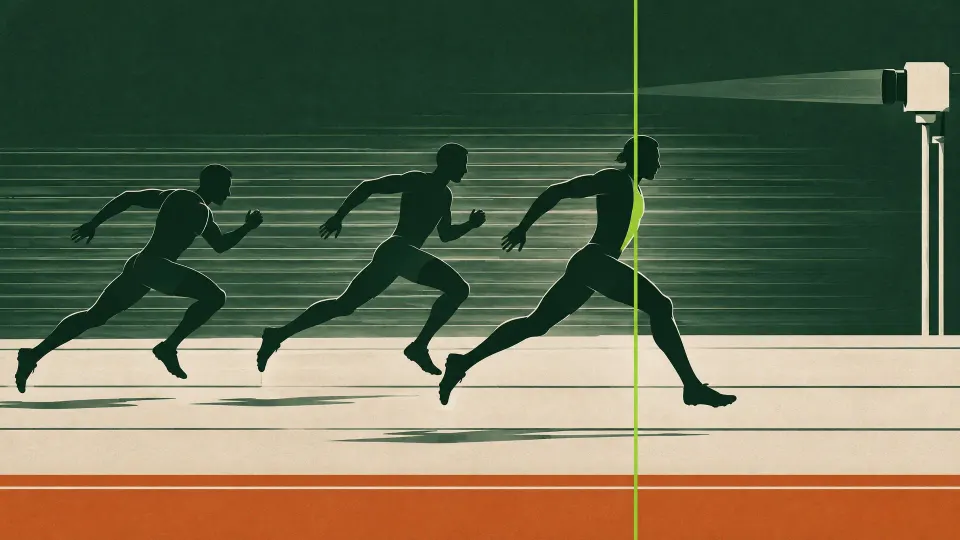
In track athletics, placing is decided when the torso reaches the vertical plane of the nearer edge of the finish line. A head, hand, arm, leg or foot ahead does not win by itself. Officials read the aligned photo-finish image; identical displayed hundredth-second times do not necessarily mean a tie.
Which body part decides an athletics photo finish?
World Athletics Technical Rule 18.2 names the torso and excludes the head, neck, arms, legs, hands and feet. The front of the chest is a useful viewing cue, but “torso” is the legal reference. Twisting or leaning can make its leading edge harder to identify. Judges must locate the relevant torso boundary rather than use whatever looks furthest forward.
| What reaches the plane first? | Does it decide the place? | What to check instead |
|---|---|---|
| Foot or spike | No | The torso may still be behind another runner. |
| Outstretched hand or arm | No | Arm movement is excluded from the finish criterion. |
| Head or neck | No | A nod alone does not move the legal reference to the head. |
| Torso during a lean or fall | Yes, subject to the race’s other rules | Locate the leading valid torso boundary. |
| Loose number bib ahead of the body | Not a substitute for the torso | Judge where the body actually reaches the plane. |
The IAAF Photo Finish Guidelines, June 2015, explain the torso/upper-arm boundary using the outer articulation of the collarbone and the lower boundary through the hip line. They also warn against placing the cursor on a bib that is not in contact with the leading body section. That is why “the shoulder wins” can be misleading: the upper arm is not simply counted as torso. Current Technical Rules control if an older guideline conflicts with them.
Where exactly is the finish line?
For a standard track finish, the white line is 50mm wide. The decisive plane rises from the nearer edge as the runners approach. Reaching that edge counts; crossing the far edge of the full painted stripe is not required. The plane extends vertically, so a torso can meet it above the track. You cannot settle the call from which shoe touches the paint first.
Picture a fixed upright sheet at that nearer edge. A hand can reach through it while the torso is still behind. A second athlete’s torso can arrive earlier even with both feet trailing. This is a teaching description, not a measurement of an actual photograph.
How to read a photo-finish image
An official line-scan finish image combines narrow views of the finish plane over time. It is not an ordinary wide-angle photograph showing every runner at one shared instant. Along its time scale, the image records when each body part passed that fixed line. Bodies can look stretched, compressed or distorted because they were moving while the image was assembled.
- Confirm the image is the official finish-plane image and identify its labelled time scale; do not assume every screenshot runs left to right.
- Identify each athlete using lanes or the official identification record, then find the leading torso rather than a limb or loose bib.
- Read the judge’s torso cursor against the time scale and compare the official places; check the final classification for disqualifications or amendments.
| Element | Meaning | What it is not |
|---|---|---|
| Time scale across the composite image | Passage through one fixed plane over time | Distance gaps across the track at one instant. |
| Torso cursor | Judge’s reading of the decisive body boundary | A line drawn through whichever limb is ahead. |
| Lane/athlete identity | Who produced each finish trace | Proof based only on a cropped or obscured bib. |
| Official place | Order established by the authorised reading | Necessarily the order guessed from broadcast footage. |
Use the time labels, not a guessed image direction. Do not estimate a metre gap by measuring the horizontal spacing of two bodies in the composite. That spacing represents time on this image; it is not a conventional map of their separation on the track. Nor does a stretched head mean that the athlete physically changed shape.
Why can runners have the same time but different places?
The official order comes from the photo-finish reading. For fully automatic track races up to and including 10,000m, the published time is converted to the next longer hundredth unless it is already an exact hundredth. That display step can put distinct readings into the same printed time. It is not ordinary rounding to the nearest hundredth.
| Runner | Illustrative underlying reading | Published hundredth | Order if the image separates them |
|---|---|---|---|
| A | 10.001 seconds | 10.01 seconds | Ahead of B |
| B | 10.008 seconds | 10.01 seconds | Behind A |
| C | Exactly 10.010 seconds | 10.01 seconds | The exact hundredth does not increase again |
A and B display the same 10.01 even though A’s torso arrived earlier in this example. The extra digits illustrate the conversion rule; they are not a claim that every system or result page publishes thousandths. Read the places alongside the times. Technical Rule 21 separately uses actual times to 0.001 second when resolving a last time-qualifying place or a seeding tie.
Do not export that hundredth rule to every race. Fully automatic track races longer than 10,000m use the next longer tenth; races partly or wholly outside the stadium generally use the next whole second, with a road-mile exception. Hand timing has its own conversion. Event type and timing method must be known before reading the number.
What happens if the official photo finish cannot separate the runners?
Technical Rule 21.1 says that if the judges cannot separate athletes for a place under the applicable finish/timing rules, the tie remains. They must not manufacture a winner from an arm, head or an inconclusive television angle. A shared published time alone is not enough to establish that situation; the official reading must be unable to separate the place.
Qualification is a separate administrative question. If a true tie affects the last place qualifier, available lanes or positions may allow the tied athletes into the next round; where that is not practicable, the rules provide for drawing lots. A last qualifying position based on time requires comparison to 0.001 second first. None of this turns a tied final into a winner selected by last stride or reaction time.
Does a dive at the finish count?
The torso rule still applies if an athlete leans or falls across the finish. There is no separate bonus for diving, and an early hand or head landing beyond the line does not decide the place. The athlete’s conduct can still be examined under other race rules, including obstruction. This explanation is not a recommendation to dive or a substitute for coaching and safety advice.
Why a broadcast freeze-frame is not the official decision
A television camera may be offset from the finish plane, and its frame rate or motion blur may not resolve the arrival order. Perspective can make a foot in one lane look ahead of a torso in another. The finish system is aligned to the plane and its images are checked by the Chief Photo Finish Judge. Current rules call for an official camera designation and supplementary views where needed to resolve obscured athletes.
Olympics.com’s 2 May 2025 explanation describes the line-scan method used in Paris and its multiple camera views. Its equipment figures describe that event, not the minimum required in every athletics meeting. Read the technical rule and actual event setup before claiming all finish cameras have the same scan rate.
Can the first torso across still lose the race?
Yes, if the final classification removes the athlete for an infringement. Finish order and eligibility are different questions. A provisional scoreboard may appear before the track officials confirm there are no disqualifications. Always look for the official amended result rather than treat a dramatic image or immediate graphic as the whole outcome.
For a clear close-finish report, state the official places and published times, identify the torso criterion, and use an exact margin only when an authorised source gives it. Do not invent thousandths from a video pause. If the result is provisional or under review, say so.
Different sports use different finish references; swimming, cycling and wheelchair athletics should not inherit this track-runner torso explanation without checking their own rules. For other result-reading questions, see long-jump marks, wind and countback, combined-event points and running totals and why equal high-jump marks are not always a tie. Visit the Athletics desk and athletics archive for related coverage.
This article presents SportsHub4U editorial coverage. Where recorded, supporting sources and their access dates appear below. A publication-control check is not a human reviewer’s endorsement or a guarantee of factual accuracy. See the editorial standard for automation and correction procedures.