Sources and update record
Record updated: . This is the saved modification date, not a separate fact-check date.
Sources: 6 named sources listed below; 6 with an access date.
Reported status: No separate status recorded. Read the dated article; do not assume it is a live or final result.
Production: No separate production-method record. This is not a claim of human review or first-hand reporting.
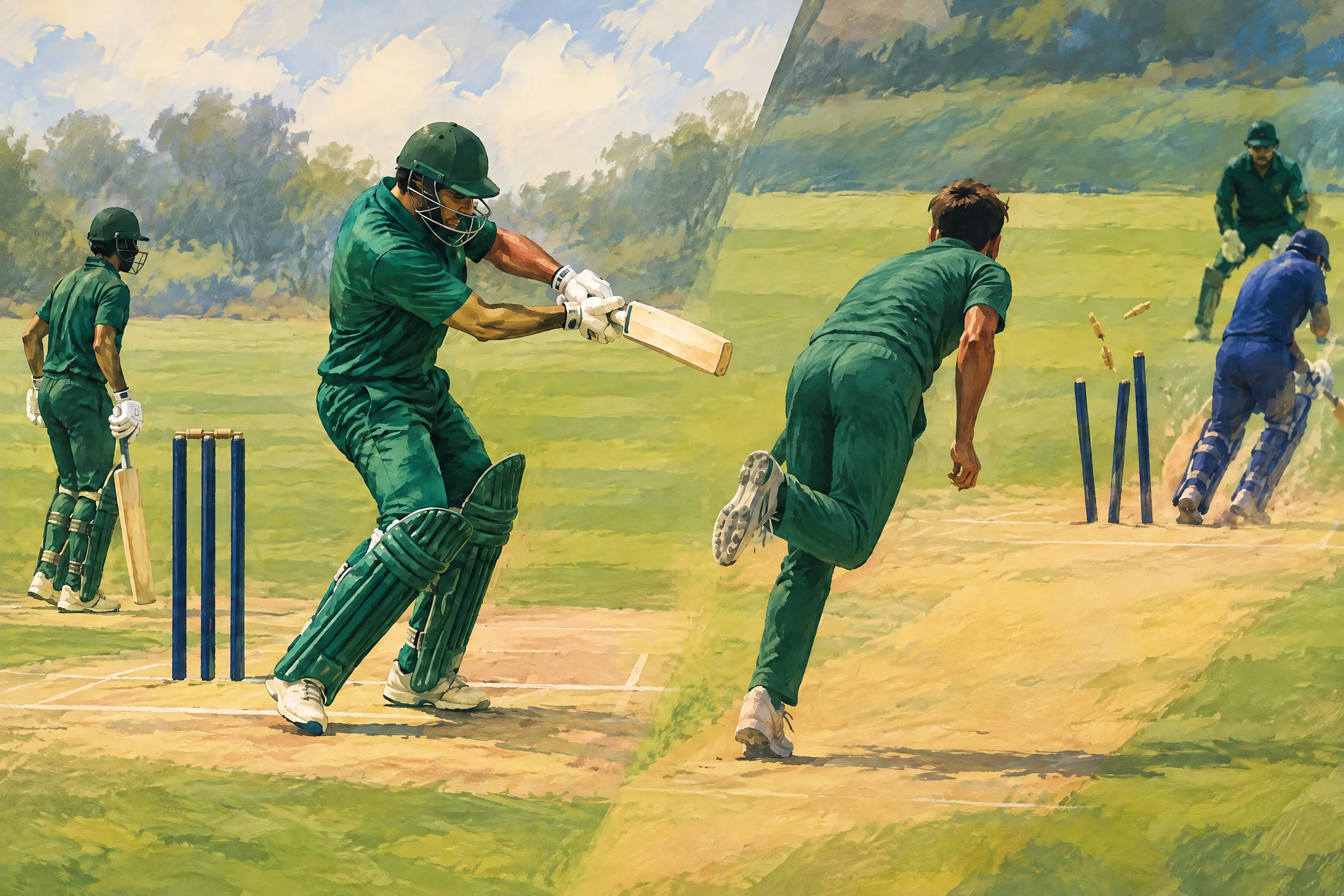
A stumping dismisses the striker when a delivered ball is not a No ball, the striker is out of their ground without attempting a run, and the wicketkeeper fairly breaks the wicket without another fielder intervening. Run out is broader: either batter can be dismissed while out of their ground, whether or not attempting a run, subject to the law’s exceptions.
Run out versus stumped: the decision checklist
| Question | Stumped | Run out |
|---|---|---|
| Which batter? | The striker only. | Either batter, at the end belonging to their ground. |
| Must a run be attempted? | No run attempt is part of the stumping test. | A run attempt is not generally required. |
| Who breaks the wicket? | The wicketkeeper, without another fielder intervening. | A fielder’s action or a ball rebounding from a fielder, with the stated exceptions. |
| Can it happen on a Wide? | Yes, unless the winning Wide has already ended the match. | Yes, if the run-out conditions apply before the match ends. |
| Can it happen on a No ball? | No. | Yes in permitted circumstances, but the keeper-only/no-run striker exception matters. |
| Does the bowler get a wicket? | Yes in the bowling analysis. | No, even if the bowler is the fielder making the run out. |
A batter charging down the pitch to play a shot has not necessarily attempted a run. Conversely, a wicketkeeper can run a batter out during a run attempt. “Keeper did it” is not enough to classify the dismissal. When all the stumping conditions are met, Law 39.1.2 gives stumping priority even if run out would otherwise be justified.
Out of the ground and a fairly broken wicket
Some part of the batter’s person or bat must be grounded behind the popping crease at the relevant end. The line itself is not behind it. There is a specific protection for a batter running or diving towards and beyond the ground: after first grounding bat or person beyond the crease, a subsequent loss of contact does not automatically make that batter out of the ground. Do not apply that running/diving protection to every unrelated lifted-foot situation.
Under Law 29, a bail must be completely removed from the top of the stumps, or a stump removed from the ground, in one of the permitted ways. A disturbed bail alone is insufficient. If a fielder uses a hand or arm to break the wicket, the ball must be held in the hand being used, or in the hand of that arm. Separate provisions govern a wicket with a bail already off or when the umpires have dispensed with bails.
The No ball exception that changes the answer
| Situation | Classification | Reason |
|---|---|---|
| Fair delivered ball; striker misses, remains out of ground, no run attempt; keeper alone fairly breaks wicket | Stumped, if no other exception applies | All Law 39 conditions are satisfied. |
| Wide; same keeper-only/no-run situation; the Wide does not win the match | Stumped; Wide extra remains | A Wide is not a No ball. |
| No ball; striker out of ground, no run attempt; keeper alone fairly breaks wicket | Not out by stumping or this run-out route | Law 38.2.2.2 excludes that keeper-only No ball case. |
| No ball; striker attempts a run and keeper fairly breaks wicket while the striker is out of ground | Run out can apply | The no-run-attempt requirement of the No ball exception is absent. |
| No ball; another fielder intervenes before keeper fairly breaks wicket with striker out of ground | Run out can apply | The keeper-only exception no longer fits; other Law 38 tests still apply. |
| Fair ball; another fielder returns the ball to keeper for a wicket break during a run attempt | Run out, not stumped | A run attempt and fielder intervention prevent stumping. |
The call of No ball does not itself make the ball dead. MCC Law 21.17 allows only hit the ball twice, obstructing the field or run out from a No ball. That permission does not remove run out’s own exceptions. Where a free hit applies under the competition conditions, check its separate dismissal limits too; see the free-hit guide.
The table covers ordinary cases without a batter’s runner. MCC has specific runner provisions, and competition conditions can disallow runners. The officials must apply the full relevant rule to an actual match; a short comparison is not a replacement for it.
Keeper rebounds, injury avoidance and early departure
The wicketkeeper does not have to remove the bail directly with a glove. Under Law 39.2, a ball rebounding from the keeper’s person or equipment, or kicked or thrown by the keeper, can count as the keeper breaking the wicket. The other stumping conditions must still be satisfied.
A striker who leaves their ground after receiving the delivery to avoid injury is not out stumped under Law 39.3.1. Law 38 also protects a batter who had been within their ground and subsequently left it to avoid injury. Do not describe every out-of-ground injury-avoidance case as an automatic wicket.
For the non-striker leaving early, Law 38.3 defines a specific window: from the ball coming into play until the bowler’s arm reaches the highest point of the normal delivery swing. After that point, the bowler cannot use this early-departure provision to run the non-striker out, even if the batter left before it. This is a run-out rule, not a stumping rule.
How to read the dismissal row and bowling figures
| Displayed label | What it means | Bowling analysis |
|---|---|---|
| st Keeper b Bowler — 24 | The batter was stumped by the named keeper off the named bowler; 24 is the batter’s innings score. | One wicket credited to the bowler. |
| run out (Fielder) — 24 | The batter was run out with the named fielding involvement; 24 is the batter’s innings score. | No wicket credited to the bowler for that dismissal. |
| run out (Bowler) — 24 | The bowler made the fielding action. | Still not a bowler-credited wicket. |
| Team total 80/3; fall of wicket 3–80 | The third dismissal occurred at a team score of 80. | This is not the dismissed batter’s score. |
Providers may abbreviate stumping as “st”, “stp” or a full word, and may list several fielders for a run out. Read the dismissal type and attribution together. Do not replace a missing fielder with the bowler’s name simply because the wicket fell during that bowler’s over. A team’s wicket total can therefore exceed the sum of its opponents’ bowler-credited wickets.
New Zealand Cricket’s introductory scoring guide records a stumping with the keeper in the “how out” entry and the bowler in the bowler column. It explicitly excludes run outs from the bowler’s wicket tally. Its 2013 document is used here for that basic scorekeeping convention, not as authority for every current playing-condition detail.
Runs, extras and ball count after the dismissal
| Event | Runs or extras | Legal-ball count |
|---|---|---|
| Run out during an attempted second run after one valid run is completed | The completed run stands; the run in progress does not, subject to specific runner provisions. | Read the delivery status; a run-out label alone does not decide the count. |
| Stumping from a Wide that does not end the match | The one-run Wide penalty stands. | The Wide does not count as a legal delivery. |
| Permitted run out from a No ball | The No ball penalty stands, with other runs scored under the relevant laws. | The No ball does not count as a legal delivery. |
| The Wide penalty supplies the winning run | The match is already concluded. | A later stumping is not part of the match. |
Over notation is not decimal arithmetic: 12.3 means twelve complete overs plus three legal balls. A summary may show runs and wickets without delivery-by-delivery detail. It cannot establish which exact ball produced the dismissal unless the provider actually supplies that information.
A scorecard-reading routine
- Find the actual dismissal type, not just a highlight caption.
- Separate the batter’s runs from the team’s fall-of-wicket score.
- Check whether the delivery was a Wide or No ball and whether play had already ended.
- Use the wicketkeeper/fielder attribution that the provider confirms.
- Check bowler credit separately: stumping counts, run out does not.
- Treat absent delivery or player data as unavailable, not zero.
SportsHub4U’s summary-only fallback can show verified team totals and match status without a full player scorecard. This guide explains notation; it does not fill absent dismissals, fielders, balls or bowling figures. For rain-affected chase labels see DLS target versus par; for tie-break rows see the Super Over guide.
Browse the Cricket archive or Cricket desk for related context. The umpire’s decision, current governing conditions and recorded scorecard remain the authority for the actual dismissal.
- MCC — Law 38 — Run out, including No ball exception and bowler creditAccessed 2026-10-12
- MCC — Law 39 — Stumped, priority and Wide/injury exceptionsAccessed 2026-10-12
- MCC — Law 30 — Batter out of their groundAccessed 2026-10-12
- MCC — Law 29 — The wicket is brokenAccessed 2026-10-12
- MCC — Law 21 — No ball, scoring and dismissal limitsAccessed 2026-10-12
- New Zealand Cricket — Cricket Scoring: Getting Started (2013) — basic dismissal notation and bowler creditAccessed 2026-10-12
This update presents the reported position at publication. Check the named references and any recorded event status; an automated publication check is not human factual certification. Unfinished events must not be read as final results.