Sources and update record
Sources: 6 named sources listed below; 0 with an access date. 6 access dates are not recorded or valid.
Reported status: No separate status recorded. Read the dated article; do not assume it is a live or final result.
Production: No separate production-method record. This is not a claim of human review or first-hand reporting.
A ball striking the referee can look like an obvious reason to stop a football match. It usually is not. Referees are part of the field of play, so a routine rebound off the referee or an assistant referee can leave the ball live. The key question is not simply whether there was contact. It is whether that contact changed the game in one of three specific ways set out in the Laws. If it did, the referee stops play and uses a dropped ball. If it did not, the match carries on.
The three situations that require a stop
Law 9 of the IFAB Laws says that, while the ball remains on the field, it becomes out of play after touching a match official only if a team starts a promising attack, the ball goes directly into the goal, or the team in possession changes. In each case the restart is a dropped ball. The Football Association’s current Law 9 text confirms the same three tests. A harmless ricochet that stays with the same team and creates no promising attack is therefore not enough on its own.
Think of those tests as protection against an official accidentally becoming a decisive extra player. A pass that hits the referee and breaks to the opponents is not treated as a normal turnover. Nor may a team profit from a deflection off an official that immediately creates a promising attack. A ball that rebounds from an official straight into a goal is also not a goal. The referee stops play even though no player has committed an offence. That point matters: the dropped ball is a neutral way of restarting a stoppage for which the Laws specify no free kick, penalty, throw-in, goal kick or corner.
When contact does not stop play
The opposite is just as important. Law 9 says the ball remains in play at all other times when it touches a match official and stays on the pitch. Suppose a defender’s clearance glances off the referee but remains with the defending team, with no immediate promising attack. Play continues. The referee does not stop because the bounce was awkward or because one side feels unlucky. Viewers should also separate an official’s accidental contact from an assistant referee’s ordinary off-field position: the Law’s tests apply when the ball touches a match official and remains on the field of play.
That is why the decision can appear inconsistent from one incident to another. The same physical deflection can have a different outcome depending on possession and the next phase of play. A team need not lose the ball for a restart to be required; starting a promising attack after the contact is a separate trigger. Equally, a changed possession does not have to produce an attack before the referee intervenes. The three triggers are alternatives, not a checklist that all must be met.
The 2026/27 clarification: who should receive the ball?
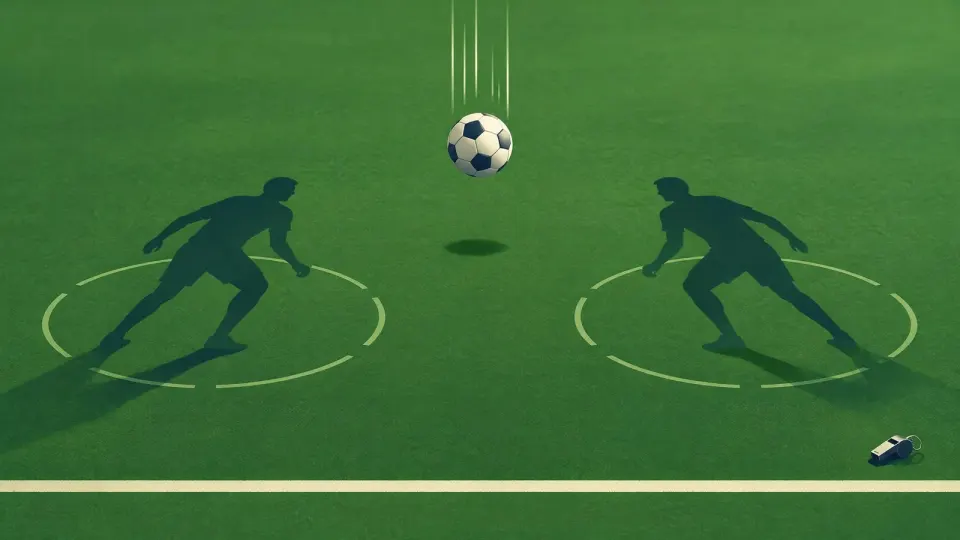
Once the whistle has gone, Law 8 determines the procedure. The 2026/27 wording clarifies that, outside the penalty area, the referee drops the ball for one player of the team that would have retained or gained possession if play had not stopped, when that can be determined. That includes the team that would have taken a restart had the ball gone out of play. When an official or an outside agent has interfered, the ball is dropped at the position of the interference or contact rather than automatically at the earlier spot where play was stopped. The FA’s explanation of the change sets out both clarifications.
This is a restoration principle, not a contest for the ball. If a pass is clearly heading out for a throw-in before it hits an assistant referee and stays in, the referee can identify the team that would have taken that throw-in and drop the ball for one of its players. If the official contact produces a possession change, the referee uses the available evidence to identify who would have retained or gained the ball without the interruption. If that cannot be determined, the Law falls back to one player of the team that last touched it. Coaching American Soccer’s 2026/27 rule overview independently notes the clarification that the drop goes to the team that would have retained or gained possession.
Location, players and the moment it becomes live
Law 8 gives the penalty area a special rule. If the ball was in the penalty area when play stopped, the referee drops it for the defending team’s goalkeeper inside that area. Outside the penalty area, it goes to one player under the possession test just described. Everyone else from both teams must be at least four metres away until the ball is in play. It becomes live when it touches the ground, not when it leaves the referee’s hand. A player who touches it before it reaches the ground causes the drop to be taken again.
The player selected to receive the drop does not have to pass at once. After the ball hits the ground, that player can play it again; there is no free-kick-style double-touch offence. But the procedure still limits direct goals. If a dropped ball goes into either goal without touching at least two players, the goal cannot stand. A direct entry into the opponents’ goal produces a goal kick; a direct entry into that player’s own goal produces a corner kick. The same retake rule applies if the ball leaves the field after touching the ground without first touching a player.
How to read the decision in real time
A quick sequence makes the restart easier to follow. First, did the ball touch a match official and remain on the pitch? If not, use the normal out-of-play or restart rules. Second, did the touch directly create a promising attack, a change of possession or a goal? If none occurred, play should continue. If one did occur, the referee stops play for a dropped ball. Third, locate the ball: inside the penalty area means the defending goalkeeper receives it; outside, the referee identifies the team that would have had the ball, or uses the last-touch fallback if that judgment cannot be made.
The important lesson is that a referee is not automatically a ‘dead ball’. The Laws allow ordinary rebounds to remain part of play while preventing the official’s accidental involvement from creating a major advantage, a turnover or a goal. That balance explains both the immediate whistle in the exceptional cases and the lack of a whistle in routine ones. It also explains why the restart is a controlled, single-team dropped ball rather than the old-style contest between players. For another decision that turns on a precise legal trigger rather than the appearance of an incident, read our guide to offside position and offside offences.
- The International Football Association Board (IFAB) — Law 9: The Ball in and out of PlayAccessed 28 September 2026
- The International Football Association Board (IFAB) — Law 8: The Start and Restart of PlayAccessed 28 September 2026
- The Football Association — Law 8: The Start and Restart of Play (IFAB Laws of the Game 2026/27)Accessed 28 September 2026
- The Football Association — Law 9: The Ball in and out of Play (IFAB Laws of the Game 2026/27)Accessed 28 September 2026
- The Football Association — 2026/27 law changes explainedAccessed 28 September 2026
- Coaching American Soccer — IFAB preview of Law changes 2026/2027Accessed 28 September 2026
This article presents SportsHub4U editorial coverage. Where recorded, supporting sources and their access dates appear below. A publication-control check is not a human reviewer’s endorsement or a guarantee of factual accuracy. See the editorial standard for automation and correction procedures.