Sources and update record
Sources: 7 named sources listed below; 0 with an access date. 7 access dates are not recorded or valid.
Reported status: No separate status recorded. Read the dated article; do not assume it is a live or final result.
Production: No separate production-method record. This is not a claim of human review or first-hand reporting.
A ball sailing towards the boundary can produce cricket’s most confusing dismissals. A fielder may catch it, flick it back while airborne, or pass it to a teammate. The crowd sees athleticism; the umpire must apply a sequence of boundary and catching rules. The central point is simple: a catch is not fair merely because the ball never touches the grass. The fielder’s relationship with the boundary, and the moment at which the catch is completed, matter too.
There is one important qualification before judging any replay. The Laws are written by Marylebone Cricket Club (MCC), but international matches use competition playing conditions. MCC says those conditions can create subtle differences, and the ICC publishes separate documents by format and competition. The revised MCC Laws are due to take effect on 1 October 2026, while the ICC Women’s T20I Playing Conditions already use the revised boundary wording. For a particular match, start with that competition’s current playing conditions.
Start with the first contact
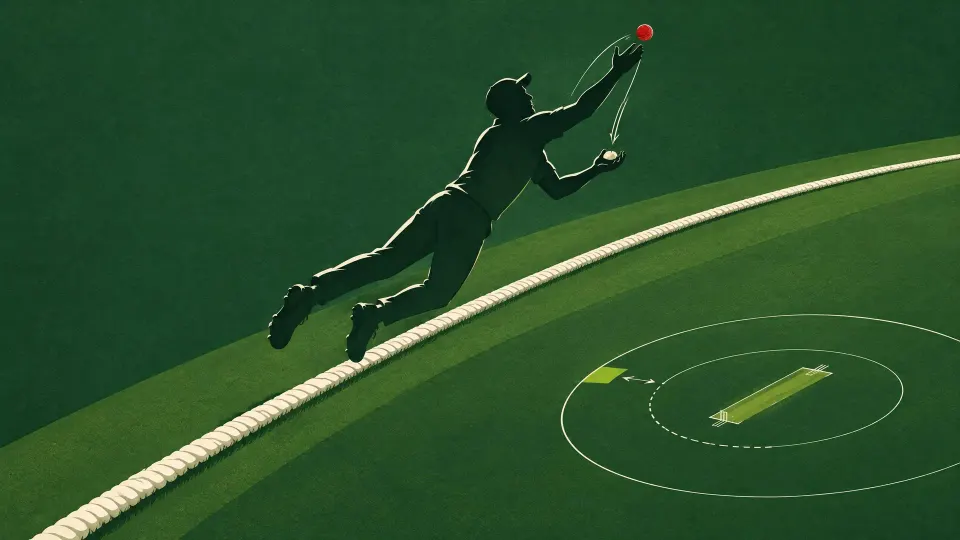
The first question is not “Did the fielder land inside?” It is: was the fielder eligible to make that first touch of the ball? Under the revised Clause 19.5.2, an airborne fielder is treated as grounded beyond the boundary if their final contact with the ground before their first contact with the ball was not wholly inside the boundary. The clause also applies if the ball has already been touched by another fielder.
In practical terms, a fielder cannot stand beyond the rope, leap in, and claim the first touch as though the rope did not exist. Their last ground contact before that first touch must have been completely inside the field. This is why a slow-motion replay often begins several steps before the apparent catch. The relevant evidence is not just the hands and ball; it is also the last place the player was grounded.
A boundary marker counts. A player touching the rope or an object that marks the boundary is grounded beyond it. The ball is also treated as grounded beyond the boundary when a fielder who is grounded beyond it touches the ball. When an attempted catch comes from a batter’s stroke, that outcome normally means six: a struck ball first grounded beyond the boundary scores a boundary six even if it previously touched a fielder.
The revised one-airborne-touch limit
A legal first touch does not give a fielder unlimited freedom to juggle the ball outside the rope. The revised wording addresses the unusual “bunny-hop” sequence that made older highlights so difficult to judge. After a fielder who made an eligible first touch jumps from outside the boundary and contacts the ball while airborne, every later contact that fielder makes with the ground before the ball becomes dead must be inside the field of play. If the player then lands outside, or later steps outside, a boundary is scored.
The most useful shorthand is one airborne chance after going outside. It is only shorthand, not a replacement for the full test. The first touch must still be legal, and the rule concerns what happens after the player has made that airborne contact from beyond the boundary. A fielder may not repeatedly use ground outside the rope as a launchpad while keeping the ball alive.
This rule also matters when the ball is not held by the first fielder. Suppose a player parries the ball back into the field for a teammate. If that player had jumped from outside the boundary to make the contact, they must land and remain inside until the ball is dead. A relay does not erase the first player’s boundary obligation.
A teammate’s catch still has to be fair
A spectacular parry is only part of the decision. The eventual catcher must still complete a fair catch. Law 33 requires that neither the ball nor a fielder in contact with it is grounded beyond the boundary before completion. It also says that making the catch begins at first contact and ends only when a fielder has complete control of both the ball and their own movement.
That final phrase explains why a catch can remain under review after the ball appears secure. A fielder who has the ball in their hands but is still falling has not necessarily completed the catch. If their movement carries them onto the rope or ground beyond it while they remain in contact with the ball, the catch fails. Conversely, a ball may cross the boundary in the air and still be caught fairly if all the boundary and control conditions are met.
A quick replay checklist
When watching an attempted boundary catch, work through four questions in order. First, where was the fielder’s last ground contact before the first touch? Second, if the fielder went outside, did they use only the permitted airborne contact and then keep all later ground contact inside until the ball was dead? Third, if there was a relay, did every relevant fielder satisfy the boundary condition? Finally, did the eventual catcher control the ball and their movement before any prohibited grounding?
This sequence is more reliable than deciding from a single freeze-frame. It also explains why a catch that looks extraordinary can be out, while an equally athletic effort can be six. The Laws reward skill, but they preserve a real boundary: once the applicable rule says the ball or a fielder touching it is grounded beyond the rope, the fielding side cannot convert that stroke into a catch.
For a different Laws question involving a batter rather than a boundary fielder, see when a batter out of the ground is run out or stumped.
- MCC — MCC announces new edition of Laws from 1 October 2026Accessed 25 September 2026
- MCC — MCC Laws of Cricket 2017 Code, Fourth Edition 2026Accessed 25 September 2026
- ICC — ICC Women’s T20I Playing Conditions, July 2026Accessed 25 September 2026
- MCC — MCC: About the Laws of CricketAccessed 25 September 2026
- ESPNcricinfo — ESPNcricinfo: MCC changes law to make boundary catches with bunny hops illegalAccessed 25 September 2026
- Cricket Australia — Cricket Australia: Boundary catches explained: Why is that not a six?Accessed 25 September 2026
- BBC Sport — BBC Sport: MCC changes Laws of Cricket to permit previously illegal batsAccessed 25 September 2026
This article presents SportsHub4U editorial coverage. Where recorded, supporting sources and their access dates appear below. A publication-control check is not a human reviewer’s endorsement or a guarantee of factual accuracy. See the editorial standard for automation and correction procedures.