Sources and update record
Sources: 4 named sources listed below; 0 with an access date. 4 access dates are not recorded or valid.
Reported status: No separate status recorded. Read the dated article; do not assume it is a live or final result.
Production: No separate production-method record. This is not a claim of human review or first-hand reporting.
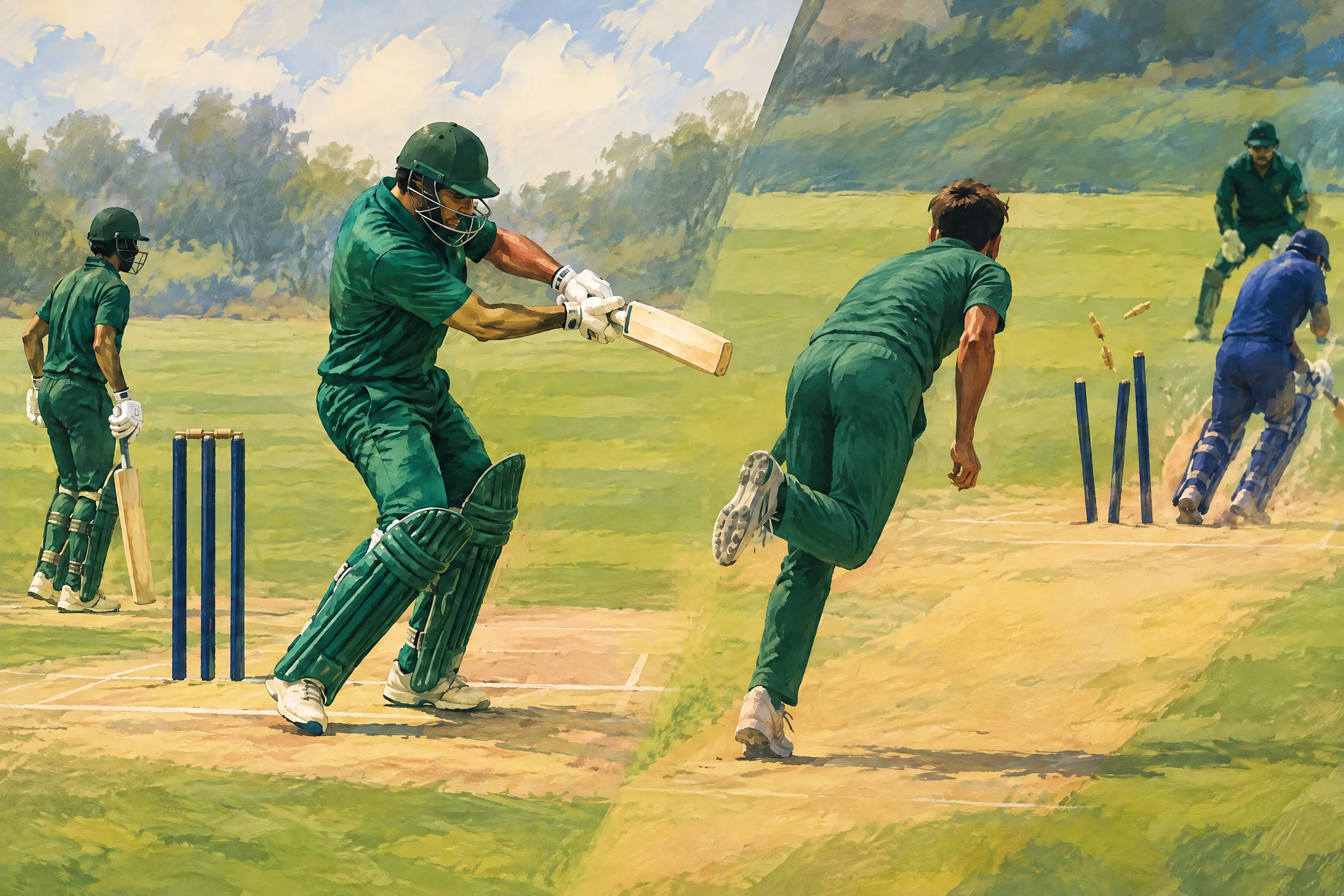
A Test score can look as though the batting order has gone wrong: Team B has batted, then is sent straight back out to bat again while Team A waits. That is the follow-on. It is not a bonus innings or a penalty imposed by an umpire. It is a tactical option available to the captain of the side that batted first after that side has established a large enough first-innings lead. The purpose is to give the leading team more time to take the 20 wickets needed for a win.
The reliable starting point is the MCC’s Law 14 on the follow-on, checked against the ICC Men’s Test Match Playing Conditions. Both set out the standard Test rule: the side that batted first needs a first-innings lead of at least 200 runs before it has the option to require the other side to follow on. “Option” is crucial. Reaching 200 does not make the decision automatic, and the side that batted second never obtains this particular option, however large its own lead may later become.
Start with the lead, not the first total
The threshold is a lead, not a score. If Team A makes 472 and Team B replies with 246, Team A leads by 226. It may enforce the follow-on because 472 minus 246 is more than 200. By contrast, a side that makes 620 but concedes 450 has a 170-run lead, so it cannot enforce in a standard five-day Test. This simple subtraction prevents a common mistake when viewers see a very large first innings and assume the rule must apply.
The captain must tell both the opposing captain and the umpires that the option is being taken. Once that notification is made, it cannot be reversed. The trailing side therefore begins its second innings immediately, rather than waiting for the leading side to bat again. In the ordinary order, a two-innings match runs A, B, A, B. After a follow-on it runs A, B, B, and then A only if a fourth innings becomes necessary.
What the numbers mean after the follow-on
Return to the 472 versus 246 example. Team B begins its second innings 226 runs behind overall. If it is dismissed for 180, its two innings total 426 and Team A wins by an innings and 46 runs; there is no chase because Team B has not even drawn level. If Team B reaches 226 in the second innings, it has erased the deficit. Every run after that gives Team A a target for a possible fourth innings. So a score of 246 and then 310 does not mean Team B is “310 ahead”; it means Team B has made 556 across its two innings and has set Team A 85 to win.
This is why an innings victory is a distinct result. It means the team that batted first did not need its second innings at all. It should not be confused with winning “by an innings” simply because one team enforced the follow-on: the trailing team can bat long enough to make the leading side chase, and rare comebacks have done exactly that. For any live match, calculate from the combined totals before declaring that a target exists.
Why a captain may enforce it
Time is the immediate attraction. A captain who sends the opposition in again does not spend an additional innings batting, which may preserve sessions to force a result before the scheduled finish. The fielding side may also wish to maintain pressure on a batting unit that has just been dismissed cheaply. Independent explanations by ESPNcricinfo and KeepTheScore both identify time and momentum as part of that calculation.
That does not mean “enforce whenever eligible” is the best rule of thumb. The bowlers have just completed an innings in the field and would be asked to bowl again without the rest gained while their own side bats. A captain can instead decline the follow-on, bat again, extend the lead and make the opposition bat last. That can rest the attack and may make use of a pitch expected to become harder to bat on. ESPNcricinfo’s analysis also highlights bowler workload, time remaining and pitch wear as factors rather than treating the 200-run margin as a tactical instruction.
The shorter-match thresholds
Law 14 scales the minimum lead to the scheduled duration of a two-innings match: 150 in a three- or four-day match, 100 in a two-day match and 75 in a one-day two-innings match. If no play takes place on the first day of a match lasting more than one day, the rule uses the number of days remaining from the start of play; the day on which the first over starts counts as a whole day. The MCC law and the ICC Test conditions give the same standard thresholds and notification procedure.
Those numbers are a reason to read the competition document, not a reason to guess. Test cricket uses the 200-run standard in the ICC Men’s Test conditions, but a domestic fixture may have a shorter scheduled duration and therefore a different qualifying lead. A competition can also publish playing conditions for a particular event. Before arguing that a captain “could have” enforced, confirm the match format, the scheduled duration, whether the first day was lost and the playing conditions that govern that fixture.
A quick way to read the decision
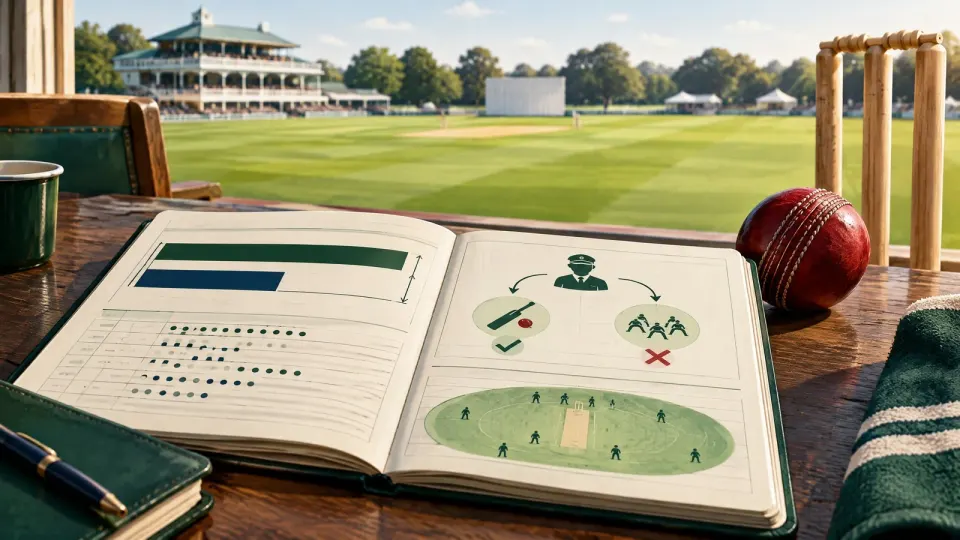
Use four checks. First, did this side bat first? Second, is this a two-innings match, and what duration do its governing conditions specify? Third, subtract the second side’s first-innings score from the first side’s score and compare the result with the applicable threshold. Fourth, if the threshold is met, look for a formal decision by the captain, not merely a commentator saying the side is “in a position to enforce”. Only then should the scorecard’s changed innings order be read as a follow-on.
The follow-on is therefore both a rule and a choice. The law supplies a threshold and a procedure; the captain weighs time, bowlers, the surface and the size of a possible fourth-innings target. Once you separate eligibility from enforcement, a seemingly strange scorecard becomes much easier to follow. For another cricket Laws distinction that often changes a scorecard, read our guide to run out versus stumped.
- Marylebone Cricket Club (MCC) — Law 14: The follow-onAccessed 26 September 2026
- International Cricket Council (ICC) — ICC Men’s Test Match Playing Conditions, effective June 2025Accessed 26 September 2026
- ESPNcricinfo — Why captains choose not to follow-on these daysAccessed 26 September 2026
- KeepTheScore — What is the follow-on in cricket? The rule explainedAccessed 26 September 2026
This article presents SportsHub4U editorial coverage. Where recorded, supporting sources and their access dates appear below. A publication-control check is not a human reviewer’s endorsement or a guarantee of factual accuracy. See the editorial standard for automation and correction procedures.