Sources and update record
Sources: 8 named sources listed below; 8 with an access date.
Reported status: No separate status recorded. Read the dated article; do not assume it is a live or final result.
Production: No separate production-method record. This is not a claim of human review or first-hand reporting.
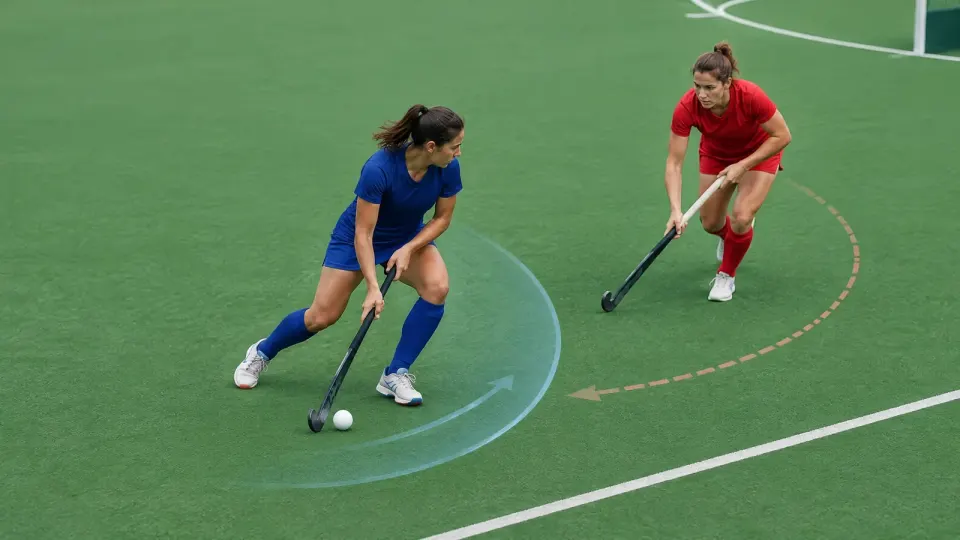
A player can turn their back to a defender, keep the ball on the far side of the body and still play legally. Shielding is not automatically obstruction. In outdoor 11-a-side hockey, the decisive question is narrower: has the player obstructed an opponent who is attempting to play the ball?
That wording is useful because it keeps attention on access to the ball rather than on appearances. A back-to-goal stance, a low body position or a defender’s complaint does not settle the call. The umpire has to identify a real attempt to play the ball and then decide whether the ball-carrier, their stick or another player took that opportunity away.
Start with the opponent’s attempt to play the ball
Rule 9.12 of the FIH’s 2026 outdoor rulebook says players must not obstruct an opponent who is attempting to play the ball. It then names three ways this can happen: backing into an opponent, physically interfering with an opponent’s stick or body, and shielding the ball from a legitimate tackle with the stick or any part of the body. The NFHS’s published field-hockey guidance describes the same practical boundary: using the body or stick to stop an opponent attempting to play the ball can be obstruction.
The rule also protects an ordinary receiving position. A stationary player receiving the ball may face any direction. That matters when a player collects a pass with a defender close behind: simply presenting a back to the defender is not, by itself, the offence.
The position changes once the ball-carrier moves. The FIH text permits a player with the ball to move in any direction, except bodily into an opponent or into a position between the ball and an opponent who is within playing distance and attempting to play it. NFHS makes the same distinction for a receiver: facing any direction is permitted while stationary, but moving the body to shield against an opponent in playing distance who is making a legitimate tackle is not.
For a viewer, that means the key moment is often the first movement after reception. Did the player take the ball into space, or did they step or lean into the route of a defender who had a legitimate chance to play it? The former can be normal possession play. The latter can turn protection into obstruction.
Body position is not the whole decision
It is tempting to call every back-to-goal situation “shielding.” That shortcut misses the two conditions built into the rule: the opponent must be attempting to play the ball, and the barrier must deny that attempt. A nearby defender is not necessarily being obstructed, but a ball-carrier cannot make a legitimate tackle impossible by backing in or stepping across the defender’s route. The relevant facts can change quickly as the ball and both players move.
A stick can create the barrier too
Obstruction is not limited to the torso or legs. The FIH rule expressly includes shielding the ball from a legitimate tackle with the stick, and the NFHS guidance likewise identifies use of the stick to prevent an opponent from attempting to play the ball. The same two questions apply: is there a legitimate attempt to play the ball, and did the stick deny it?
An obstruction decision should turn on whether the action actually prevented a legitimate tackle, not on the mere fact that players came together.
A teammate can obstruct without touching the ball
The player nearest the ball is not the only one who can obstruct. Rule 9.12 calls it third-party or shadow obstruction when a player runs in front of or blocks an opponent to stop them legitimately playing, or attempting to play, the ball. USA Field Hockey’s umpiring guidance applies that wording to a penalty corner, including when an attacker runs across or blocks defenders or the goalkeeper.
This is why off-ball runs need attention. A teammate who is genuinely moving to receive a pass may not be screening anyone. But a player who crosses a defender’s path solely to keep that defender away from the ball-carrier can commit the offence even without a touch. The question remains access: was an opponent stopped from making a legitimate play on the ball?
Penalty corners make the issue easier to see because defenders are running out while attackers are moving through the circle. The rule specifically says the third-party provision also applies when an attacker runs across or blocks defenders, including the goalkeeper, while a penalty corner is being taken. A corner routine does not create an exception to the obstruction rule.
Read the signal, then replay the action
The FIH has separate signals for ordinary obstruction, third-party or shadow obstruction and stick obstruction. USA Field Hockey lists the same three conduct-of-play categories in its signal guide.
The signal identifies the type of offence seen; it does not replace the underlying question about an attempt to play the ball. On a replay, pause at the moment the route closes, rather than only at contact.
- Was the opponent trying to make a legal play on the ball? Proximity alone is not the whole test.
- Was the opponent within playing distance when the route closed? A player who has no chance to reach the ball has not necessarily been denied a tackle.
- What formed the barrier? Look separately for backing in, a body movement across the route, stick shielding or an off-ball screen.
- Was the action by the ball-carrier or a teammate? The answer separates direct shielding from third-party obstruction.
- Which signal was shown? It can confirm whether the umpire identified ordinary, stick or third-party obstruction.
Check the competition context
This is a guide to the FIH concept, not a substitute for a live umpiring decision or a competition handbook. The FIH publishes the outdoor 11-a-side rules and allows national associations to decide their national implementation date. England Hockey’s 2026/27 guidance also tells participants to check the specific regulations for each competition because variations from the standard rules can apply.
For broader rule-led coverage, visit the SportsHub4U Hockey hub. To understand a different phase of play, read the site’s guide to reading a field-hockey press before the turnover. Together, the two explainers distinguish what happens when a defender loses access to the ball from how a team tries to create that pressure in the first place.
- International Hockey Federation — Rules of Hockey 2026Accessed 2026-09-24
- International Hockey Federation — Rules of Hockey — Official DocumentsAccessed 2026-09-24
- USA Field Hockey — Behind the Whistle Scenario: Penalty Corner ObstructionAccessed 2026-09-24
- USA Field Hockey — Rules of HockeyAccessed 2026-09-24
- National Federation of State High School Associations — Field Hockey Points of Emphasis — 2025Accessed 2026-09-24
- USA Field Hockey — Umpire SignalsAccessed 2026-09-24
- International Hockey Federation — Rules of Hockey FAQAccessed 2026-09-24
- England Hockey — New Rule Guidance Season: 2026/2027Accessed 2026-09-24
This article presents SportsHub4U editorial coverage. Where recorded, supporting sources and their access dates appear below. A publication-control check is not a human reviewer’s endorsement or a guarantee of factual accuracy. See the editorial standard for automation and correction procedures.