Sources and update record
Record updated: . This is the saved modification date, not a separate fact-check date.
Sources: 3 named sources listed below; 0 with an access date. 3 access dates are not recorded or valid.
Reported status: No separate status recorded. Read the dated article; do not assume it is a live or final result.
Production: No separate production-method record. This is not a claim of human review or first-hand reporting.
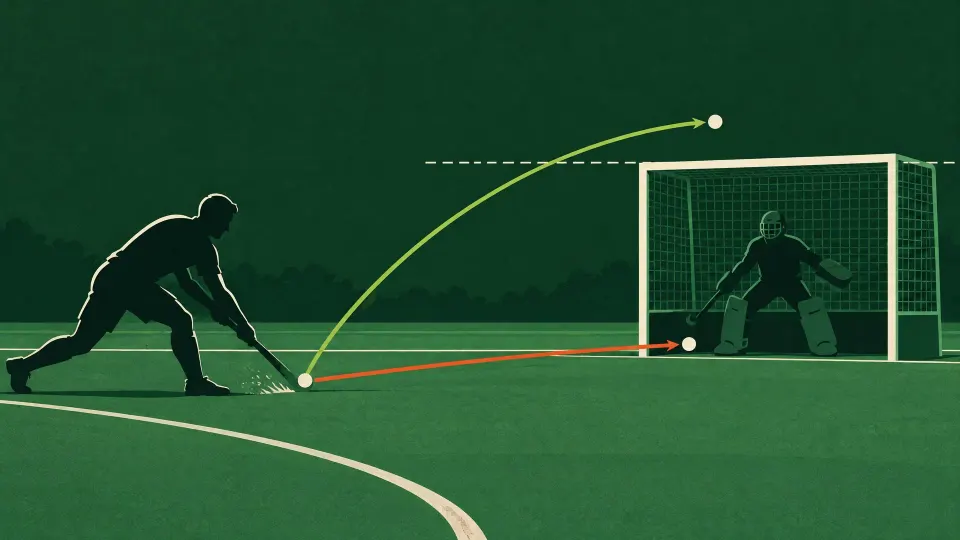
At a field-hockey penalty corner, the first shot at goal, if it is a hit, must cross the goal-line on a path no higher than 460 mm before deflection. A flick, scoop, deflection or later hit may be higher, but must not be dangerous. The difference is the shot’s type, not a blanket licence for high drag flicks.
This explanation follows FIH outdoor Rules 13.3(k)–(m), effective 1 March 2026 and checked 12 October. Its height test is specific to a penalty corner, also called a short corner. It is not an ice-hockey rule or the procedure for a penalty stroke. The umpire’s classification and the match’s competition regulations remain controlling.
First hit vs drag flick: the 460 mm decision
| Shot or action | Height condition | Still required |
|---|---|---|
| First shot at goal is a hit, including a slap hit | Goal-line trajectory before deflection no higher than 460mm | Ball must already have left circle; no danger |
| First shot is a push, flick or scoop | First-hit 460mm restriction does not apply to that technique | Legal circle exit/scoring sequence; no danger |
| Second or subsequent hit at goal | May be raised to any height | No danger and all other applicable rules |
| Deflection | May be raised if the original first-hit path was compliant | Cannot rescue an originally too-high first hit; no danger |
| Spectator calls it a drag flick | Nickname alone does not classify the action | Apply FIH hit/push/flick/scoop definitions to what occurred |
FIH defines a hit as striking or slapping with a swinging stick movement; its slap-hit guidance also covers the long sweeping movement before contact. A flick is a push that raises the ball. A scoop lifts it by placing the stick head under the ball. These are technique definitions, not a speed ranking. A fast ball is not automatically a hit, and an action called a drag flick in commentary is not automatically a legal flick.
The ball must leave the circle before a goal can count
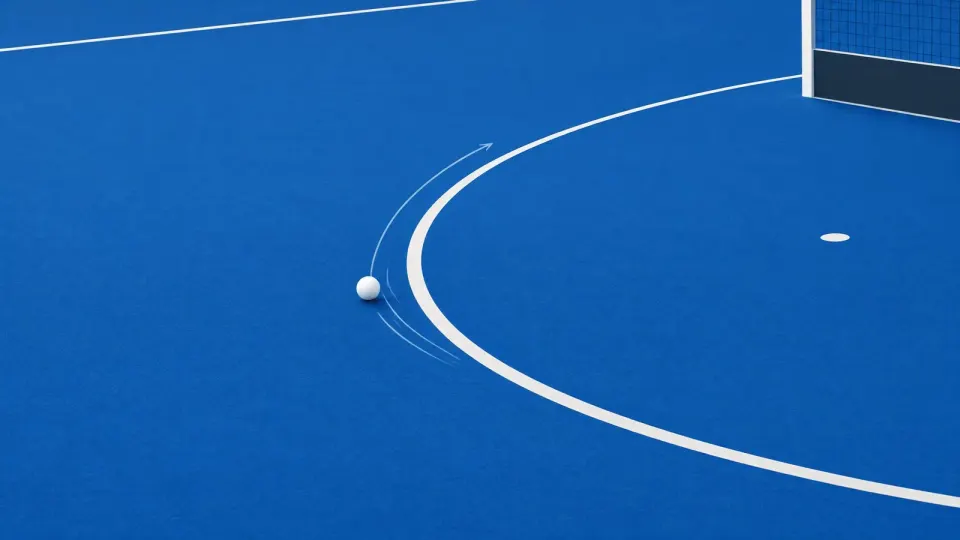
Rule 13.3(k) requires the ball to travel outside the circle before a penalty-corner goal can be scored. The team can control and move it there; the requirement is exit, not a magical obligatory stop by a designated player. A high flick does not waive it. Nor is the inserter allowed to play the ball again or approach within playing distance until another player has played it, under Rule 13.3(j).
Setup remains important. The ball is placed on the back-line inside the circle at least 10 metres from the goal-post. The inserter pushes or hits without intentionally raising it and has at least one foot outside the field. Other attackers start outside the circle. At most five defenders, including a goalkeeper if used, are behind the back-line; remaining defenders are beyond the centre-line. Those players cannot enter or cross their starting lines before the ball is played. A team using only field players gives them no goalkeeping privileges.
Trajectory matters: a deflection does not erase the first-hit test
| Flight or deflection | Height-test assessment | Reason |
|---|---|---|
| Safe first hit rises to 600mm in flight but naturally falls to 400mm at the line | Can satisfy the first-hit height requirement | The legal test is the goal-line path, not maximum flight height |
| First hit would cross the line at 600mm; a later touch knocks it down | Cannot be rescued by that touch | Original pre-deflection path fails the 460mm test |
| Compliant low first hit is then deflected upward | Raised deflection may be permitted | Original hit was compliant; danger remains a separate assessment |
| Defender touches the ball before the first shot, then the first shot is a hit | First-hit restriction still applies | 13.3(l) explicitly preserves the requirement after defender contact |
| First hit misses the frame but its projected goal-line crossing is above 460mm | Still penalised for excessive first-hit height | The rule includes the path which would cross the line |
The measurements above are illustrative; they are not a recommendation to estimate height from a single broadcast frame. FIH permits a first hit to be above the backboard during flight only if it would drop naturally below that height at the line and creates no danger. A defender’s touch is not an automatic reset of the first shot. FHumpires’ first-hit topic page has examples of sweep-hit and deflection issues; this guide relies on the current rulebook rather than claiming to adjudicate those clips.
High flicks and danger: what the knee-height provision actually says
Rules 9.8 and 9.9 retain the danger test. Legitimate evasive action can indicate danger; flicks and scoops toward an opponent within five metres are subject to explicit dangerous-play provisions. Rule 13.3(m) then gives a particular first-shot penalty-corner test. Permission to raise a ball must never be summarised as “flicks are always legal”.
| Established circumstances | Rule outcome | Scope |
|---|---|---|
| Defender clearly runs into the shot or taker without attempting to play the ball with the stick | Defender penalised for dangerous play | This exception comes before the struck-defender distinction |
| Otherwise defender is within 5m of the first shot and is struck below the knee | Another penalty corner | Applies to the stated first-shot circumstances |
| Otherwise defender is within 5m and struck on or above the knee in a normal stance | Shot judged dangerous; defensive free hit | Not a universal high-ball ban for every distance or phase |
| Defender is farther away or facts differ | Assess the applicable general danger and penalty rules | Do not invent an automatic verdict from the knee table alone |
A legal high shot need not produce a goal; a low shot can still be dangerous. Where a circle offence prevents a probable goal, the separate penalty-stroke triggers may matter. Neither a dramatic ball flight nor contact with a player is enough to decide all those questions without the full circumstances.
Early entries and retakes: watch the lines
| Offence before entry is permitted | Next action | Team consequence |
|---|---|---|
| Non-goalkeeper defender crosses the back-line/goal-line early | Corner retaken | Offender goes beyond centre-line and is not replaced |
| Goalkeeper crosses goal-line early | Corner retaken | Defence nominates a player beyond centre-line; defends with one fewer |
| Attacker enters circle early | Corner retaken | Inserter, not automatically the entering attacker, is sent beyond centre-line |
| Inserter has no foot outside the field | Corner retaken | Apply 13.6(a), not an assumed goal award |
| Defender crosses centre-line early | Corner retaken | Apply 13.6(c) |
A repeat early crossing at the same retaken corner can remove another defender. A subsequently awarded corner is different from a retake: it may again be defended by up to five players. Attackers sent beyond the centre-line cannot return for retakes but may return for a subsequently awarded corner. These distinctions explain why a replayed set piece can have a changed defensive lineup without changing the first-hit height rule.
When is the penalty corner completed?
Rule 13.5 lists the completion conditions: a goal; a defensive free hit; the ball travelling more than five metres from the circle; the ball going over the back-line without another corner; a defender’s offence not resulting in another corner; or a penalty stroke. Rule 13.4 prolongs a quarter for completion of a corner and any subsequent corner or stroke. Do not keep applying a completed set piece’s first-shot restriction to every later attack.
The 2026 edition removes a redundant old Rule 13.3(n), but Rule 13.5 still supplies the completion conditions. The new 13.3(n) addresses safe removal of protective equipment and immediate defensive passes, not abolition of corner completion. For a different restart near the circle, read the attacking-free-hit five-metre guide. For player context, Harmanpreet Singh’s sourced profile explains the defender/drag-flick role without making technique alone proof of a legal shot.
The quickest viewing sequence is to confirm circle exit, classify the first shot, assess any first-hit trajectory before deflection, and then judge danger. The rest is the actual restart and completion context. Find related outdoor explainers in the Hockey archive; NHL/KHL reports there have a separate ice-hockey intent and must not be used as field-hockey rule authority.
- International Hockey Federation — Rules of Hockey 2026: terminology, danger and penalty cornersAccessed 12 October 2026
- USA Field Hockey — Outdoor rules listed separately from indoor and competition modificationsAccessed 12 October 2026
- FHumpires — Height of first hit on penalty corner: topic examples; current FIH rules controlAccessed 12 October 2026
This article presents SportsHub4U editorial coverage. Where recorded, supporting sources and their access dates appear below. A publication-control check is not a human reviewer’s endorsement or a guarantee of factual accuracy. See the editorial standard for automation and correction procedures.