Sources and update record
Record updated: . This is the saved modification date, not a separate fact-check date.
Sources: 4 named sources listed below; 0 with an access date. 4 access dates are not recorded or valid.
Reported status: No separate status recorded. Read the dated article; do not assume it is a live or final result.
Production: No separate production-method record. This is not a claim of human review or first-hand reporting.
An attacking free hit inside the 23-metres area cannot be played into the circle until the ball has travelled at least five metres or been touched by a defender. A self-pass or a teammate’s touch does not bypass that rule. Player spacing is a separate test: the ball’s travel and players’ distance must not be confused.
That is the direct answer in FIH Rule 13.2(f). The 2026 outdoor Rules of Hockey, effective from 1 March and checked on 12 October 2026, also require a stationary ball, the correct restart location and legal player spacing. This page explains field hockey, not an ice-hockey free puck, indoor restart or Hockey5s procedure. Check the competition’s regulations before applying an outdoor explanation elsewhere.
The two five-metre tests at an attacking free hit
| Test | Who or what it covers | What it does not mean |
|---|---|---|
| Player spacing: Rule 13.2(b/c) | Opponents generally must be 5m away; for an attacking free hit in the 23m area all other players, including teammates, must be 5m away, subject to the specified immediate-restart exception | A teammate has unrestricted permission to stand close and collect a short restart |
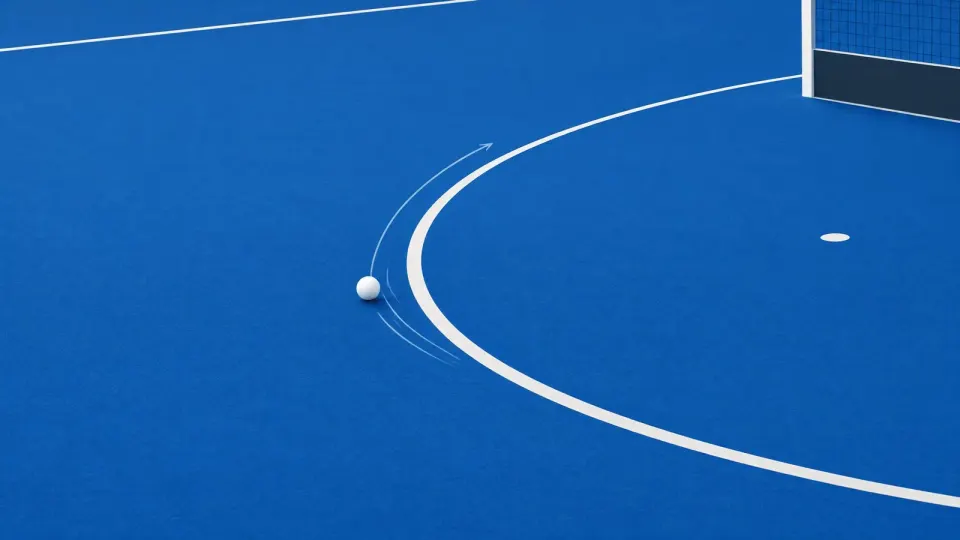
| Circle entry: Rule 13.2(f) | The ball must travel at least 5m in total, not necessarily in a single direction, or touch a defending player before it may be played into the circle | Five seconds, five steps, or any second stick touch automatically qualifies |
| Immediate self-pass near circle: guidance to 13.2(f) | Defenders already inside the circle and within 5m may shadow around its inside without playing, attempting to play or influencing the ball until the condition is met | A new right for a defender to step closer or tackle early |
The existing article described opponents’ distance but did not make the attacking-23m requirement for teammates clear enough. Rule 13.2(c) covers all other players in that situation. A player caught close is not permission for interference: the exception is narrow, and the umpire must still assess who could legitimately play the ball. The travel condition belongs to the ball. Taking one small touch and then striking into the circle has not solved it.
Self-pass examples: what permits entry?
| First movements | Circle-entry test | Why |
|---|---|---|
| Taker carries sideways 3m and then forwards 2m before entry | 5m travel condition met | Travel can add up in different directions |
| Taker carries 2m then plays directly into the circle | Condition not met on these facts | Self-pass is not an exemption |
| Ball travels less than 5m and is touched by a defender entitled to play it | Defender-touch alternative met | Any player may then play it into the circle, subject to other rules |
| Legally positioned teammate receives a short pass, with total travel still under 5m and no defender touch | Condition not met | An attacking teammate’s touch does not reset or remove the restriction |
| A nearby defender interferes before being entitled to engage | Possible spacing/interference offence | An unlawful touch must not be used as a shortcut around the distance rule |
These distances are teaching examples, not measurements of a real match. Rule 13.2(f) expressly lets the self-passing taker play the ball any number of times while accumulating the required travel. It does not require a single straight five-metre line toward goal. Once a defender has legitimately touched the ball, the taker or another player can play it into the circle. Safe play and the usual scoring requirements still apply.
Why immediate and delayed restarts differ
Picture a free hit awarded just outside the circle. A defender inside it is caught less than five metres from the restart. If the attacker takes an immediate self-pass, that defender may shadow around the inside of the circle, but cannot play or attempt to play the ball, or influence play, until it has travelled five metres or another entitled defender has touched it. Shadowing is not an early tackle.
If the attacker waits instead, all other players must be at least five metres from the ball before the restart. Do not preserve the quick-restart exception through a deliberate delay. FHumpires’ 2021 explanation helps visualise the distinction, but current 2026 FIH text controls. The USA Field Hockey Q&A is explicitly from 2020; only its cross-checked near-circle explanation is used here, not its older aerial-reception wording.
Can the ball be raised at a free hit?
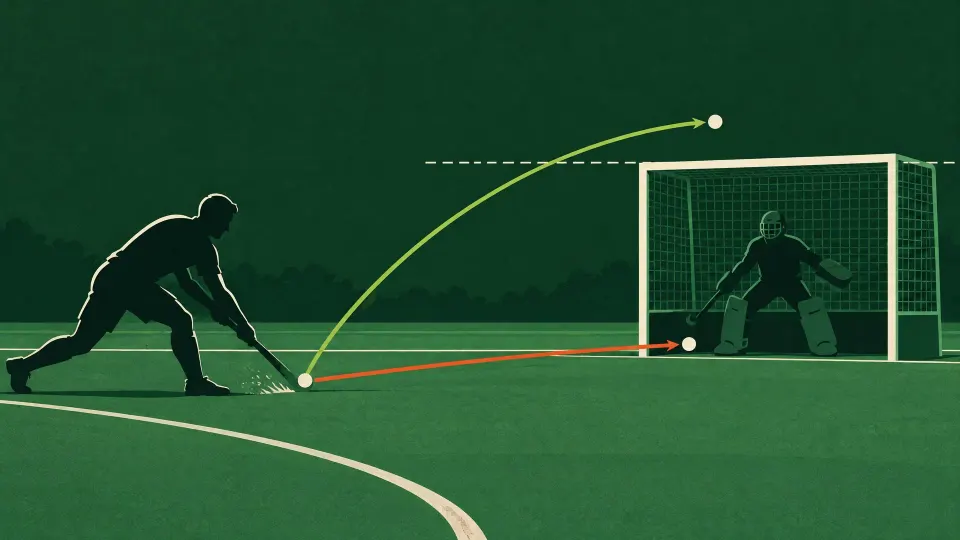
Rule 13.2(e) allows the ball to be raised immediately with a push, flick or scoop. It must not be intentionally raised using a hit. Neither permission removes the circle-entry restriction or dangerous-play rules. A skilful aerial is not automatically a legal restart just because it lands where the attacker wants it.
There is a specific over-the-circle allowance in Rule 13.2(f): the ball may be played high above the attacking circle to land outside it, provided it cannot legitimately be played inside or above the circle by another player during its flight and dangerous-play rules are respected. This is not permission to scoop directly to a receiver inside the circle before the five-metre or defender-touch condition. Distinguish flying over the area from playing into it.
Stationary ball, precise location and protective equipment
Rule 13.1 places the free hit close to the offence without a significant advantage; location must be more precise inside the 23-metres area. Rule 13.2(a) requires a stationary ball, even if briefly. A rolling ball and a favourable relocated restart can be wrong before the final pass is considered. The 2026 introduction specifically reminds umpires to enforce the stationary requirement for self-passes.
After a penalty corner, defenders still wearing protective equipment may make an immediate pass from a defensive free hit or an attacker-caused back-line/side-line restart within the 23m area. Rule 13.3(n) does not let them take a self-pass while wearing that equipment. This defensive safety clarification is separate from the attacking circle-entry test; it does not authorise an attacker’s short-cut.
A practical viewing checklist
- Identify the restart and whether it is awarded to the attack inside the 23-metres area.
- Check that the ball is stationary and at the correct location.
- Separate opponents’ spacing from the attacking-area requirement for all other players. Apply only the stated immediate shadowing exception.
- Track total ball travel or a defending player’s legitimate touch before circle entry. A teammate’s touch alone does not qualify.
- Then check danger and whether the later scoring action meets the normal circle rules.
An illegal direct entry should not be re-labelled a legal penalty corner just because it was an attacking set piece. The corner has a different procedure, explained in first hit versus drag flick. For the sanction itself, use penalty stroke versus penalty corner. Browse outdoor explainers in the Hockey archive for connected topics; the archive’s ice-hockey news follows different rules.
- International Hockey Federation — Rules of Hockey 2026: free-hit location, procedure and circle entryAccessed 12 October 2026
- USA Field Hockey — Outdoor rules and competition-specific modificationsAccessed 12 October 2026
- FHumpires — 2021 explanation of immediate near-circle free hits; cross-checked against 2026 rulesAccessed 12 October 2026
- USA Field Hockey — 2020 briefing Q&A; near-circle explanation cross-checked against 2026Accessed 12 October 2026
This article presents SportsHub4U editorial coverage. Where recorded, supporting sources and their access dates appear below. A publication-control check is not a human reviewer’s endorsement or a guarantee of factual accuracy. See the editorial standard for automation and correction procedures.