Sources and update record
Record updated: . This is the saved modification date, not a separate fact-check date.
Sources: 2 named sources listed below; 0 with an access date. 2 access dates are not recorded or valid.
Reported status: No separate status recorded. Read the dated article; do not assume it is a live or final result.
Production: No separate production-method record. This is not a claim of human review or first-hand reporting.
A penalty stroke in outdoor field hockey is a one-on-one attempt awarded for a defender’s circle offence that prevents a probable goal, or an intentional circle offence against an opponent with possession or an opportunity to play the ball. A foul in the circle is not automatically a stroke. The offence and its effect decide the award.
This guide follows the FIH Rules of Hockey effective 1 March 2026, checked on 12 October 2026. Rules 12.3 and 12.4 decide the award; Rules 13.7–13.9 govern the attempt. It concerns outdoor field hockey, not an ice-hockey penalty shot, Hockey5s or a tie-break shoot-out. National and competition regulations must be checked separately.
Penalty stroke vs penalty corner: what did the offence stop?
| Situation established by the umpire | Normal award | FIH basis |
|---|---|---|
| Defender’s circle offence prevents the probable scoring of a goal | Penalty stroke; intention is not an additional requirement for this route | 12.4(a) |
| Intentional defender’s circle offence against an opponent with possession or an opportunity to play the ball | Penalty stroke; this is a separate route | 12.4(b) |
| Defender’s circle offence does not prevent a probable goal and does not meet the intentional-opponent trigger | Penalty corner | 12.3(a) |
| Intentional circle offence against an opponent without possession or an opportunity to play the ball; no probable goal prevented | Penalty corner | 12.3(b) |
| Intentional defender’s offence outside the circle but inside the defending 23-metres area | Penalty corner, not a stroke solely for being deliberate | 12.3(c) |
| Unintentional defender’s offence outside the circle within the defending 23-metres area | Free hit to the attack | 12.2(c) |
First decide whether an offence disadvantaged the opponents: Rule 12.1 is the advantage principle. A ball contacting a foot is not a complete decision on its own. “Probable goal” does not mean a guaranteed goal, but it is more than a possible chance later in the attack. Conversely, an intentional offence against an attacker who could play the ball has its own stroke test; it need not be squeezed into the probable-goal route.
Two hypothetical circle decisions
Example A: a defender illegally stops a shot that the umpire judges would probably score. That can meet Rule 12.4(a), even if the offence was not intentional. Example B: a non-intentional breach stops a pass near the circle edge, with no probable goal prevented. On those stated facts, a penalty corner fits Rule 12.3(a). These are teaching scenarios, not verdicts on a recorded match. Change the intent, the attacker’s opportunity or the shot’s likely outcome and the correct award can change.
An intentional stick or body obstruction against an attacker able to play the ball may engage Rule 12.4(b). That does not make every shield an offence. Read the separate obstruction explanation before treating a player’s body position as proof. Where video review exists, the competition’s referral process determines the available route; it is not available at every match.
How a penalty stroke is taken
- Time and play stop. Place the ball on the penalty spot, whose centre is 6.40 metres from the inner edge of the goal-line.
- Everyone except the taker and defending player stands outside the 23-metres area without influencing the attempt.
- The taker starts behind and within playing distance of the ball. The defender starts with both feet on the goal-line.
- The umpire whistles when both are in position. The taker waits for that whistle; after it, the defender cannot leave the line or move either foot until the ball is played.
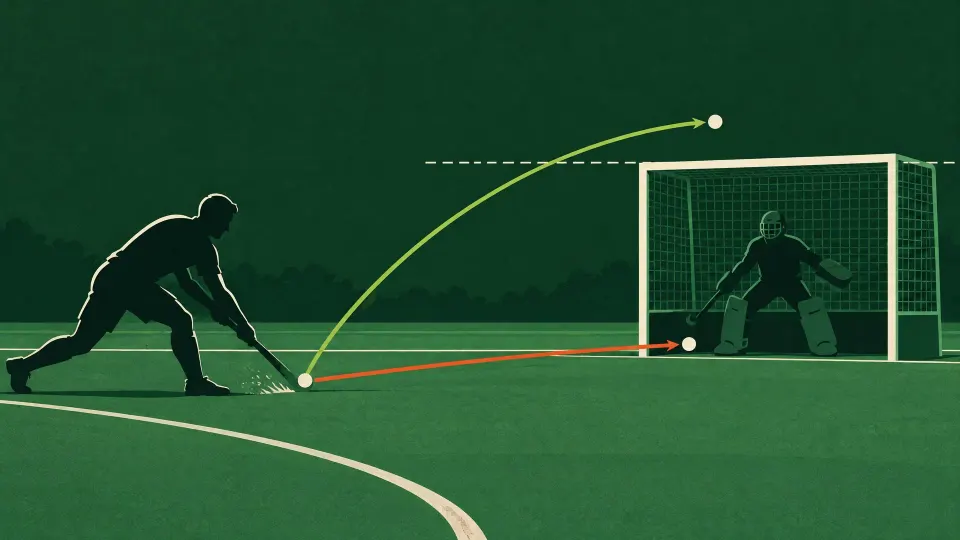
- The taker uses one push, flick or scoop, potentially raised to any height. A hit, dragging action, feint or second play of the ball is not permitted.
- After playing the ball once, the taker cannot approach the ball or the defender. This is not a chance to follow up a rebound.
A penalty corner permits a different technique and a multi-player sequence. In particular, “drag flick” at a corner must not be treated as permission for a dragging action at a stroke. The actual movement is what matters, not the technique’s nickname. The first-hit versus flick guide explains the separate corner height test.
Penalty-stroke offences: when is it retaken?
| What happens | Outcome | Condition |
|---|---|---|
| Taker plays before the whistle and the ball enters the goal | Retake | 13.9(a) |
| Taker plays before the whistle and no goal is scored | Defensive free hit | 13.9(b) |
| Another offence by the taker, such as feinting, dragging or playing twice | Defensive free hit | 13.9(c) |
| Defender moves a foot early or commits another offence and no goal is scored | Retake | 13.9(d) |
| Goal is scored despite an offence by the defending player | Award the goal | 13.9(d) guidance |
| Another defending-team player offends and no goal is scored | Retake | 13.9(e) |
| Another attacking-team player offends and the ball enters the goal | Retake | 13.9(f) |
The early-foot provision also has a personal-penalty sequence. If the defender prevents a goal but moves a foot early, they may be cautioned; a subsequent offence requires a green-card suspension, and further offences a yellow card. Those consequences are distinct from whether the stroke is retaken. If the defending side uses a field player rather than a substituted goalkeeper, that player has no body-saving privileges: only the stick may make the save, with only a face mask permitted as protective equipment.
When the attempt ends, and why it is not a shoot-out
Rule 13.8 completes the stroke when a goal is scored, or the ball comes to rest inside the circle, lodges in the goalkeeper’s equipment, is caught by the goalkeeper, or leaves the circle. Do not describe a moving rebound as a new stroke or let the taker chase it. A tie-break shoot-out is a separate competition-regulation procedure; it is not the one-touch stroke described here. If a commentary graphic says “penalty”, identify which procedure the umpire awarded before applying these limits.
For the next phase, use the attacking-free-hit circle-entry guide or browse the field-hockey explainers in the Hockey archive. That archive also holds ice-hockey reports; its shared “Hockey” category does not make NHL or KHL rules apply here. No match score, alleged officiating error or player statistic is inferred from these examples.
- International Hockey Federation — Rules of Hockey 2026: penalties and taking proceduresAccessed 12 October 2026
- USA Field Hockey — Outdoor rules and separately listed national/NCAA modificationsAccessed 12 October 2026
This article presents SportsHub4U editorial coverage. Where recorded, supporting sources and their access dates appear below. A publication-control check is not a human reviewer’s endorsement or a guarantee of factual accuracy. See the editorial standard for automation and correction procedures.